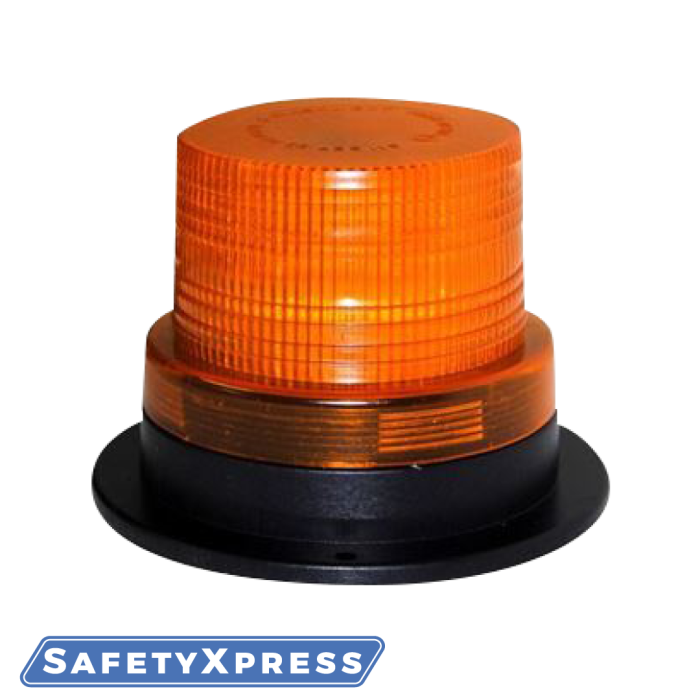
A forklift reverses out of a warehouse loading bay while two workers move pallets across the yard. Nearby, a maintenance vehicle has its amber beacon flashing. A second warning light remains steadily illuminated beside a temporary pedestrian barrier.
Which light will the workers notice first?
Most people would probably choose the flashing beacon. Its repeated changes in brightness make it stand out from objects that remain visually unchanged.
That assumption has some scientific support. Flashing lights often attract attention more effectively than steady lights under comparable conditions. But the difference becomes less predictable when a workplace contains multiple moving vehicles, flashing machinery indicators, reflective surfaces and other competing signals.
In certain situations, a steady light may provide clearer information than another flashing beacon.
The distinction matters in South African warehouses, construction sites, industrial yards, mines and roadworks, where warning lights are frequently used to alert people to moving equipment and temporary hazards.
Choosing between flashing and steady warning lights should involve more than deciding which one looks brighter.
The objective is to make sure people recognise the hazard, understand the warning and have enough time to respond.
Key Takeaways
- Flashing warning lights generally attract attention more readily than steady lights because their changing brightness creates a noticeable visual signal.
- Steady warning lights can be useful for identifying fixed hazards, boundaries and areas that need continuous visual guidance.
- More flashing lights do not necessarily create a safer workplace, especially where competing signals cause visual clutter.
- Flash rate, brightness, colour, viewing angle and background lighting influence warning light performance.
- Excessively bright flashing lights can create glare, particularly during night-time operations.
- Coordinated flashing patterns can help drivers understand a route more clearly than random flashing.
- A warning light should communicate a specific hazard rather than simply attract attention.
- South African roadworks and industrial applications require different considerations when selecting warning lights.
Why Flashing Lights Usually Attract Attention Faster
The human visual system is particularly responsive to changes in the surrounding environment.
Movement, changes in brightness and sudden visual events can attract attention even when someone is concentrating on another task.
A flashing warning light takes advantage of this response.
Instead of producing a constant signal, it repeatedly changes between illuminated and less illuminated states.
Those changes make the light more noticeable against a relatively stable background.
A steady light behaves differently.
Once it has been recognised, it becomes part of the surrounding visual environment. Someone concentrating on another activity may be less likely to notice it again unless something changes.
Research reviewed by the former US National Bureau of Standards found that flashing lights of comparable luminance were generally detected faster than steady lights in experiments involving competing visual distractions.
However, that finding does not establish a universal reaction-time advantage for every workplace or warning light.
The size of the advantage depends on the visual environment, light characteristics and task being performed.
The practical lesson is that flashing can help attract initial attention, but it does not automatically make every warning clearer or safer.
The Difference Between Getting Attention and Providing Guidance
Warning lights can perform different functions. Some are intended to attract immediate attention to a hazard.
Others help people identify the location of an obstruction or follow a particular route.
These functions are related, but they are not identical. Imagine a construction site entrance where delivery vehicles regularly cross a pedestrian walkway.
A flashing amber beacon might alert approaching workers that a vehicle is entering the area.
A steady warning lamp positioned along a temporary barrier could help people recognise the boundary of the pedestrian route.
The flashing light communicates that something requires attention. The steady light provides a continuous visual reference.
Both may be useful, depending on the arrangement. Problems develop when every warning light is treated as interchangeable.
A flashing light may be appropriate for a temporary or changing hazard, while a steady light may be better suited to a fixed boundary that needs to remain visible.
Why Busy Work Areas Change the Results
A quiet warehouse corridor provides a relatively simple visual environment. There may be a few signs, overhead lights and limited vehicle movement.
A flashing warning light in that setting is likely to stand out. Now consider a large industrial yard during a busy afternoon.
Several forklifts are operating, delivery trucks are reversing, machinery indicators are flashing and workers are wearing reflective clothing.
Sunlight reflects from metal surfaces and vehicle windscreens. In this environment, another flashing beacon has to compete with many existing signals.
The visual system cannot give equal attention to everything. A warning light may be bright and functioning correctly but still fail to attract the attention expected of it.
This is why the number of warning lights matters. Adding more flashing devices without considering their purpose can make the environment visually complicated.
A well-designed warning system uses distinctive signals where they provide useful information rather than simply increasing the number of flashing lights.
What Research Says About Flashing Patterns
A published study titled Toward the Development of Standards for Yellow Flashing Lights Used in Work Zones examined how drivers responded to different warning light arrangements.
Researchers varied light intensity and flashing patterns in a simulated roadworks environment.
The findings were particularly interesting because they showed that flashing behaviour can influence how drivers interpret a work area.
During daytime testing, drivers’ responses were relatively insensitive to several warning light characteristics.
However, participants generally preferred sequential and synchronised flashing patterns over random, uncoordinated flashing.
At night, the researchers found that sequential flashing could provide useful guidance through the work zone without requiring unnecessarily high light intensity.
The study also distinguished between warning drivers that a work zone is approaching and helping them follow the correct path through it.
These are two different tasks.
A conspicuous warning light near the start of the work area may attract attention, while a coordinated series of lights can help communicate the intended route.
The study focused on roadworks rather than warehouse operations, so its findings should not be applied directly to every industrial environment.
Nevertheless, it demonstrates why the pattern of illumination matters as much as the decision to use flashing lights.
When Flashing Warning Lights Make More Sense
Flashing lights are particularly useful when the objective is to attract attention to a changing or potentially unexpected situation.
Moving maintenance vehicles
A maintenance vehicle travelling slowly through an industrial yard may be difficult to distinguish from other traffic.
A flashing amber beacon can help identify its presence and unusual operating activity.
The beacon should complement safe vehicle operation, not replace it.
Forklifts entering shared areas
A forklift moving out of a warehouse doorway may create a hazard for pedestrians or other vehicles.
A suitably designed warning system can alert people to the movement.
Where appropriate, the warning light may be linked to vehicle detection or access controls so that it communicates a specific event.
Temporary construction hazards
A flashing warning light can help draw attention to a temporary obstruction or changed traffic arrangement.
This may be useful where workers or drivers are unfamiliar with the hazard.
Roadworks approaching a lane closure
Flashing warning lights may help approaching motorists recognise that the road environment is changing.
They should form part of the approved traffic accommodation arrangement.
Equipment operating outside normal conditions
Certain machines use flashing indicators to communicate faults, movement or operating states that require attention.
The meaning of the signal should be clearly established and understood by workers.
When Steady Warning Lights Can Be More Useful
Steady lights are sometimes overlooked because they do not attract attention as dramatically.
However, they can provide a useful continuous reference.
Consider a temporary pedestrian route through a large industrial facility.
The route may need to remain clearly identifiable throughout a night shift.
A series of appropriately positioned steady lights could help define its location without introducing constant flashing along the entire walkway.
A similar principle can apply to fixed obstructions or boundaries.
A steady warning lamp may help people recognise the position of an object that remains in the same place.
The key advantage is consistency.
Once the person understands what the steady light identifies, it continues providing the same information.
This does not mean steady lights are always preferable for fixed hazards.
The appropriate mode depends on the equipment, relevant standards and the nature of the warning.
Why Too Many Flashing Lights Can Become a Problem
Imagine a warehouse where every forklift has a flashing beacon.
A maintenance vehicle also has a beacon, while several loading bays use flashing warning lamps.
At first, the signals may attract attention.
Over time, workers may become accustomed to seeing them.
This is often described as habituation: repeated exposure to a stimulus can reduce the attention it receives.
The issue is not that the lights stop working.
It is that their warning value may become less distinctive when flashing is a constant feature of the environment.
Another problem is confusion.
If several lights flash independently, workers may struggle to determine which signal relates to the hazard nearest to them.
A warning system should make the hazard easier to understand.
If workers cannot tell what a particular light means, its effectiveness may be limited even when it is clearly visible.
Does a Faster Flash Rate Mean a Better Warning?
Not necessarily.
A faster flashing light may appear more urgent, but increasing the flash rate does not guarantee a faster or more appropriate response.
The visual effect depends on how frequently the light changes, how long each flash lasts and the surrounding conditions.
A very slow flash may be easy to overlook between illuminated periods.
A very rapid flash may appear visually different and can create additional discomfort or distraction.
Different warning applications may have specified flash characteristics.
These requirements should take precedence over personal preference.
For industrial equipment, the meaning of a flashing signal should also be consistent with the site’s established warning system.
The objective is not to make the light flash as rapidly as possible.
It is to communicate the hazard clearly and reliably.
Why Flashing Lights Can Create Glare at Night
A warning light that appears suitable during daylight can become uncomfortable to view after dark.
The surrounding environment is darker, so the contrast between the warning light and background becomes greater.
A very bright flashing beacon may produce glare, particularly when viewed directly from a short distance.
Glare can make it harder to see other objects in the surrounding area.
For example, a driver approaching a roadworks site at night may need to identify workers, barriers, road markings and the intended traffic route.
An excessively bright warning light could make some of those details more difficult to recognise.
The research discussed earlier found that night-time warning light arrangements could provide useful directional information at relatively modest intensities under the tested conditions.
This illustrates an important principle.
More light is not always better.
A warning system needs sufficient visibility without creating unnecessary visual discomfort.
What About Bright South African Sunlight?
Daytime visibility presents a different challenge.
Under strong sunlight, the surrounding environment becomes much brighter.
The warning light must compete with sunlight reflected from roads, vehicles, buildings and equipment.
A flashing light may still attract attention, but its effectiveness depends on the contrast between the illuminated and unilluminated states.
A low-output warning lamp may appear highly noticeable indoors and become difficult to recognise outdoors.
Lens design and viewing angle also matter.
A light may appear bright when viewed directly from the front but much less visible from the side.
For South African roadworks, construction sites and industrial yards, warning lights should be selected for the actual lighting conditions in which they will operate.
A product intended mainly for night-time use should not automatically be assumed suitable for bright daytime applications.
Flashing vs Steady Warning Lights: A Practical Comparison
| Consideration | Flashing warning lights | Steady warning lights |
| Initial attention | Often more noticeable because of changing brightness | May be less conspicuous against a busy background |
| Fixed boundary identification | Can work, but repeated flashing may be unnecessary | Provides continuous visual reference |
| Moving hazards | Often useful for attracting attention to movement or unusual activity | May be less distinctive for unexpected events |
| Visual clutter | Multiple flashing signals can become confusing | Usually creates less temporal visual activity |
| Night-time glare | Bright flashes can produce discomfort | Can still cause glare if excessively bright |
| Power consumption | Depends on output, electronics and duty cycle | Depends on output and operating design |
| Best application | Attention to a particular hazard or changing condition | Continuous identification of a location or boundary |
The table describes general characteristics, not mandatory rules for every warning light.
The correct choice depends on the hazard, product and applicable requirements.
What South African Roadworks Guidance Says
Warning lights used on public roads should be considered within the relevant traffic management framework.
The South African Road Traffic Signs Manual provides guidance for roadworks signing and temporary traffic accommodation.
Volume 2, Chapter 13 discusses the use of flashing warning lights at locations such as lane-drop tapers, road closures, excavations near the travelled way and certain restricted-clearance situations.
The manual identifies several factors that should be considered when flashing lights are installed, including mounting height, flash frequency, brightness under daytime and night-time conditions, and maintenance.
It also notes that the edition does not provide a dedicated South African specification for roadworks flashing lights and refers readers to external standards for additional technical detail.
Source: South African Department of Transport – Roadworks Signing, SARTSM Volume 2 Chapter 13
The applicable requirements should be confirmed with the responsible road authority and the current project specifications.
A warning light should never be used as a substitute for required signs, barriers or other traffic control measures.
Choosing Warning Lights for Warehouse Operations
Warehouses present particular challenges because workers and vehicles often share nearby spaces.
A warning system should be designed around the specific movement or hazard.
For example, a loading bay may have a fixed pedestrian boundary and a separate vehicle movement warning.
The boundary may need continuous identification, while a flashing signal could be activated when a vehicle begins reversing or entering the area.
This approach gives the signals different meanings.
Workers can recognise the fixed boundary without confusing it with an active movement warning.
The arrangement should also consider noise, visibility, vehicle routes and pedestrian behaviour.
Warning lights should complement physical separation, safe operating procedures and other required controls.
A flashing beacon cannot prevent a forklift from entering a pedestrian area.
It can only help communicate a warning.
Why Mining and Quarry Operations Need Special Attention
Mining and quarry environments can contain large moving vehicles, exposed surfaces, dust and substantial background noise.
These conditions can make warning signals difficult to detect or interpret. A flashing beacon may help identify moving equipment or unusual activity.
However, the signal must remain visible from the relevant approach directions. Dust can scatter light and reduce visibility.
Bright sunlight may affect contrast, while night-time operations introduce the possibility of glare.
Large vehicles may also obstruct warning lights mounted too low. For these environments, the choice between flashing and steady lighting should form part of a broader risk assessment.
Warning lights are only one component of effective vehicle and pedestrian safety.
Why Warning Light Positioning Matters More Than Many Buyers Expect
A powerful warning light installed in the wrong position may provide little benefit. Consider a beacon mounted behind a structural column near a warehouse entrance.
It may be clearly visible from one direction but completely obscured from another. The same problem can occur when warning lights are installed behind stored materials, parked vehicles or machinery.
Mounting height and orientation influence the directions from which the light can be seen. A rotating or multi-directional beacon may provide different coverage from a directional warning lamp.
Before installation, identify where the people who need the warning will be positioned. The light should be visible from those locations with enough time for an appropriate response.
Can Warning Lights Cause Distraction?
Yes, particularly when they are excessively bright, poorly positioned or used without a clear purpose.
A warning light is intended to attract attention, but attention is a limited resource.
If a driver focuses on a flashing beacon, they may momentarily pay less attention to another part of the environment. This does not mean flashing lights should be avoided.
It means they should be used deliberately. A warning light should direct attention towards relevant information rather than compete unnecessarily with other safety signals.
The arrangement should make the hazard easier to recognise and understand.
How to Decide Between Flashing and Steady Lights
Before selecting a warning light, start with the hazard rather than the product.
Ask what people need to know.
- Do they need to recognise that a vehicle is moving?
- Do they need to identify a fixed obstruction?
- Is the warning temporary or continuous?
Will the light be used outdoors during bright sunlight or inside a warehouse at night?
These questions help establish the appropriate signal.
A practical selection checklist should consider:
- Hazard type: Is the hazard fixed, moving or intermittent?
- Warning purpose: Is the objective to attract attention or identify a boundary?
- Viewing conditions: Will the light be used during daylight, at night or both?
- Visual clutter: How many other warning lights operate nearby?
- Approach direction: From where must workers or drivers recognise the signal?
- Light output: Is the intensity appropriate for the environment?
- Flash pattern: Does the product provide the required warning behaviour?
- Mounting: Can the light be positioned without obstruction?
- Maintenance: Can the lens, power supply and mounting be inspected easily?
- Compliance: Does the product meet the applicable workplace or road traffic requirements?
The answers may show that flashing is the better choice.
They may also show that a steady warning lamp, another type of signal or a different safety control is more appropriate.
A Practical Example: Two Warning Systems at a Loading Bay
Consider a hypothetical warehouse with a loading bay beside a pedestrian route.
Delivery vehicles reverse towards the loading dock throughout the day.
Management wants workers to recognise when a vehicle is moving and understand where the pedestrian boundary begins.
One possible arrangement uses steady lights to help identify the fixed boundary, where such lighting is appropriate.
A separate flashing warning signal activates when vehicle movement creates a particular hazard.
The distinction helps workers understand the meaning of each light.
The steady signal identifies the area.
The flashing signal indicates a change requiring attention.
However, this arrangement should not be treated as a complete safety solution.
The loading bay may still require physical barriers, designated pedestrian routes, reversing procedures and other controls identified through the site’s risk assessment.
The example illustrates how different warning light modes can communicate different information without relying on flashing everywhere.
Why Maintenance Affects Both Types of Warning Lights
Neither flashing nor steady warning lights remain effective without appropriate maintenance.
Dust and dirt can accumulate on lenses.
UV exposure may gradually affect certain plastic components.
Battery-powered lights can become dimmer or stop operating when their power supply deteriorates, depending on the design.
Mounting brackets may loosen through vibration or accidental contact.
A flashing light may continue operating while producing insufficient output for the intended conditions.
A steady light may remain illuminated but become difficult to distinguish against a bright background.
Regular inspections should therefore assess visibility as well as basic operation.
The question is not simply whether the light switches on.
It is whether people can still recognise the warning from the necessary positions.
Conclusion
Flashing warning lights often attract attention faster than steady lights because their changing brightness makes them more noticeable.
That advantage is useful when people need to recognise an unexpected or changing hazard.
However, steady warning lights can provide valuable continuous guidance, particularly where a fixed boundary or obstruction needs to remain visible.
The safest choice depends on the purpose of the warning.
A busy industrial environment filled with flashing beacons does not automatically become safer with the addition of another flashing light.
Effective warning systems use signals that are visible, understandable and appropriate for the hazard.
For South African warehouses, construction sites, mines and roadworks, the objective should be to help workers and drivers recognise what is happening and respond correctly.
A warning light that attracts attention is useful.
A warning light that communicates the right information at the right moment is far more valuable.
Frequently Asked Questions
1. Are flashing warning lights more noticeable than steady lights?
Flashing lights are generally more effective at attracting initial attention because they create changes in brightness. However, their effectiveness depends on the visual environment, light intensity, flash pattern and other competing signals.
2. When should steady warning lights be used?
Steady lights can be useful for continuously identifying fixed hazards, boundaries or obstructions where appropriate. The correct application depends on the operating environment and relevant safety requirements.
3. Can too many flashing lights become distracting?
Yes. Multiple flashing signals can create visual clutter and make it harder for people to identify which warning relates to a particular hazard. Warning systems should use clearly defined signals rather than relying on flashing everywhere.
4. Are flashing lights better for warehouse forklifts?
Flashing beacons can help identify moving forklifts or unusual vehicle activity, but their effectiveness depends on visibility, placement and the surrounding environment. They should complement pedestrian separation and other workplace safety controls.
5. Do flashing warning lights work better at night?
Flashing lights can be highly noticeable at night because of the contrast with darker surroundings. However, excessive intensity can create glare. The correct output and flash characteristics should be selected for the intended conditions.
6. Can steady and flashing warning lights be used together?
Yes, where the arrangement is appropriate and the signals have clear meanings. For example, steady lighting may identify a fixed boundary while a separate flashing signal warns of active vehicle movement. The system should be designed so that people understand what each signal communicates.