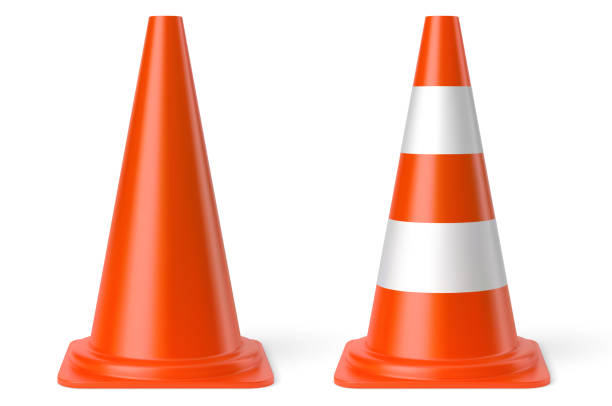
A road cone sitting beside a lane doesn’t actually explain very much on its own. It doesn’t tell a driver exactly what has changed, how far the restriction extends, where the traffic should move, or what is waiting further ahead. What it does is help make a temporary change to the road visible, and that distinction matters more than it might seem.
Think about the way a driver approaches a temporary work area. They may see a line of cones moving gradually across part of the road, perhaps with a sign positioned further back and workers operating somewhere beyond it. The cones are not the entire warning system. They are one of the things that makes the temporary arrangement understandable to somebody approaching it at speed.
That is really what road cones do best. They turn an otherwise confusing or easily missed change in the road environment into something that is physically visible and recognisable from a distance, helping guide road users through an area that isn’t operating normally.
Key Takeaways
- Road cones are primarily used to make temporary changes to traffic movement visible and help guide road users.
- A cone does not provide the complete warning by itself; signs, barriers, markings, lighting and the overall traffic arrangement may all contribute to the message.
- The spacing and positioning of cones can be just as important as the cones themselves.
- Cones can help create a temporary traffic path, separate moving vehicles from work areas and draw attention to hazards.
- A poorly arranged line of cones can create confusion even when every individual cone is perfectly visible.
- Temporary traffic setups need to make sense from the road user’s perspective, not just from the perspective of the person who installed them.
A Road Cone Is Part of a Message
It’s easy to think of a road cone as a warning object. You see one, you slow down, you pay attention and you assume something is happening ahead.
But the cone isn’t really communicating a complete instruction.
If somebody places a single cone on a wide road with no other indication of what has changed, the driver still has to work out what they’re supposed to do. Is the lane closed? Is there a pothole? Is somebody working on the shoulder? Has traffic moved into another lane? Is the cone simply marking something that has been left behind?
Now imagine twenty cones arranged in a clear line that gradually moves traffic away from a work area. The meaning becomes much easier to understand because the cones are no longer individual objects. Together, they form part of a temporary traffic arrangement.
This is one of the less obvious things about cones. Their usefulness often comes from how they relate to the other cones around them, rather than from the individual cone standing on its own.
A driver doesn’t usually analyse this consciously. They simply recognise a familiar visual pattern: cones ahead, something has changed, adjust your position and continue carefully.
What Are Road Cones Actually Trying to Achieve?
There can be several things happening at the same time.
A temporary traffic setup might need to tell drivers to move left, merge into another lane, keep away from a work area, slow down, follow a temporary route or stay clear of a particular section of the road. The cones can help communicate that altered path by making the boundaries of the temporary route easier to see.
In a work zone, that can mean separating moving traffic from workers, equipment, excavations, parked machinery or materials. In another situation, cones might be used to close off a section of road temporarily while maintenance takes place.
The important point is that the cone is helping shape movement.
That’s slightly different from simply saying that cones “warn people of danger.” Sometimes the danger isn’t directly beside the cone at all. The cone may be positioned well before the actual hazard because its job is to influence what a driver does next.
For example, a line of cones might begin before a road excavation. The first cones aren’t necessarily marking the excavation itself. They’re helping create the transition from the normal road arrangement into the temporary one.
That extra distance gives the road user something to respond to rather than suddenly discovering the restriction when they’re already beside it.
Why a Single Cone Can Be Misleading
There’s a practical problem with thinking of cones as standalone warnings: people tend to give them more meaning than they actually contain.
A lone cone near a parking area could mean almost anything. Perhaps a vehicle is being moved through the area. Perhaps maintenance is taking place. Perhaps someone has placed it there to discourage parking. Without context, the object doesn’t provide enough information.
The same cone placed as part of a continuous line is completely different.
The line establishes direction and separation. A driver can see where the temporary boundary begins, how it continues and, in many cases, where they’re expected to travel in relation to it.
This is why simply adding more cones isn’t always the answer when a temporary traffic setup feels unclear. If the cones don’t create an obvious pattern, adding another few may just produce a larger collection of objects that still doesn’t tell people what to do.
The arrangement needs to make sense.
Cone Spacing Changes What People See
Spacing is one of those details that can be overlooked because a traffic setup can look perfectly reasonable when you’re standing beside it.
The driver sees something different.
They’re approaching from a distance, often at road speed, with other vehicles around them, signs to read, pedestrians to watch and a lot of visual information competing for their attention. If cones are positioned too far apart for the particular situation, the intended boundary may become difficult to recognise.
If they’re arranged too closely, the line may become visually dense without necessarily adding much useful information.
The right arrangement depends on the road, speed, traffic conditions, work being carried out and the purpose of the temporary setup. There isn’t a single spacing number that makes every cone layout correct.
This is where a useful practical test comes in: don’t only inspect the setup from inside the work area.
Stand back and look at it from the approaching driver’s perspective.
Does the temporary route become obvious before the driver reaches the first point where movement needs to change? Can they follow the line naturally? Is there a point where the cones appear to disappear into the background or become difficult to distinguish from other objects?
Those questions tell you more about the effectiveness of the setup than simply counting cones.
The First Cone Has a Different Job From the Last Cone
Another interesting detail is that cones within a temporary traffic arrangement don’t necessarily perform identical functions.
The first part of the setup may introduce the driver to the fact that something has changed. Further along, the cones establish the temporary boundary. Near the work area, they may reinforce separation from workers or equipment.
At the end of the restriction, the arrangement may gradually return the driver to the normal road layout.
Seen this way, a temporary cone line has something resembling a beginning, middle and end.
That’s useful because sudden changes are harder for road users to interpret. If a lane simply appears to vanish around a bend, for example, a driver has less time to understand the intended movement than if the temporary route develops progressively.
The cones are helping create that progression.
Cones Don’t Replace Signs
A common mistake is to treat cones as though they can communicate every instruction required at a temporary work area.
They can’t.
A cone can make a physical boundary visible, but it generally doesn’t tell somebody why the lane is closed, what speed they should travel at, whether they need to merge, or whether pedestrians should use a particular alternative route.
Those instructions may require signs, road markings, barriers, traffic-control personnel or other temporary traffic-management measures.
The cone and the sign can therefore do different jobs.
A sign communicates information. A cone helps make the altered route or boundary visible. A barrier can provide a more substantial physical separation. The overall arrangement brings these different elements together so that the road user isn’t forced to interpret each item separately.
When those elements agree with one another, the temporary setup becomes much easier to understand.
When Cones Are Guiding Traffic Rather Than Blocking It
There’s a subtle difference between using cones to close something off and using them to guide movement.
If cones are placed around a stationary piece of equipment, their purpose may be primarily to keep vehicles and pedestrians away from it. If they’re arranged along a lane, they can instead create a temporary channel through which traffic continues.
That distinction affects how the setup should be considered.
A driver travelling through a coned section isn’t simply being told “don’t go here.” They’re being shown where they should go instead.
This is why the shape of a cone line matters. A gradual taper, a bend or a change in lane position gives the road user information about the route ahead. A random collection of cones doesn’t provide the same clarity.
The temporary traffic setup should effectively answer a question that every approaching road user has, even if they never say it aloud: Where am I supposed to go now?
What Happens When the Road Changes but the Cones Don’t?
Temporary traffic arrangements have a habit of becoming less temporary than originally planned.
A job expected to take an hour can run into the afternoon. Equipment gets moved. A delivery arrives. Workers leave for a break. Traffic increases. A lane that was quiet earlier becomes busy later.
The original cone arrangement might have been perfectly sensible at 8 a.m. and much less suitable at lunchtime.
This is particularly relevant on active worksites where the environment changes throughout the day. A cone that was clearly visible when it was placed may later sit behind a vehicle, beside stored materials or in an area affected by changed traffic movement.
The cones haven’t necessarily failed. The circumstances around them have changed.
That means temporary traffic management needs to be looked at as something that requires attention during the work, rather than as a setup-and-forget exercise.
Visibility Is More Than Having a Bright Cone
Road cones are designed to stand out, but visibility isn’t determined only by the colour of the cone.
Lighting, weather, vehicle headlights, background clutter, road surface, dust and the position of other objects can all affect how easily the temporary arrangement can be understood.
At night, for example, a driver may see reflective elements differently from how they appear during daylight. In rain, wet surfaces can create glare and reflections that compete with the traffic-control equipment.
A cone can be perfectly intact and still be difficult to interpret in certain conditions.
This is why the question shouldn’t simply be “Can I see the cones?” A more useful question is “Can an approaching road user understand the temporary traffic arrangement in the conditions they’re actually going to encounter?”
Those are two very different tests.
The Work Area Is Not the Only Area That Matters
One of the easiest mistakes to make is concentrating on the immediate work area while ignoring the approach to it.
Suppose maintenance is taking place around the edge of a lane. The workers may have a neat line of cones around their equipment, but the traffic approaching from 50 or 100 metres away may not yet understand that the lane is going to close.
The problem isn’t necessarily the final barrier or cone placement. The problem is that the driver didn’t receive enough visual information early enough.
Temporary traffic management therefore extends beyond the exact location where workers are standing.
The approach, transition and exit all matter because a driver experiences the arrangement as one continuous sequence. If one part doesn’t make sense, the entire setup can feel confusing.
What Road Users Actually See
It’s useful to forget, for a moment, how the site supervisor sees the work zone.
The supervisor knows what is happening. The workers know where the excavation is. The traffic-management contractor knows why the cones have been positioned in a particular way.
The approaching driver knows none of that.
They have perhaps three or four seconds to interpret the scene before they reach it. Their attention is divided between the vehicle ahead, mirrors, road signs, pedestrians, lane markings and whatever else is happening around them.
That changes how a temporary traffic setup should be judged.
A layout that looks perfectly obvious to somebody who has been standing beside it for half an hour might be considerably less obvious to someone encountering it for the first time at normal road speed.
This is one of the reasons a walk-through or drive-through inspection from the road user’s perspective can reveal problems that aren’t obvious during a static site inspection.
Why Cones Work Better as a System
The individual cone is relatively simple. Its real usefulness comes from being part of a larger system.
A typical temporary traffic arrangement might combine:
- Road cones to define temporary boundaries and guide movement.
- Temporary signs to communicate instructions or upcoming changes.
- Barriers where a stronger physical separation is required.
- Temporary road markings where appropriate.
- Lighting or reflective features to improve visibility in darker conditions.
- Traffic controllers where people need to manage movement directly.
- Additional protection around particular hazards where cones alone aren’t sufficient.
None of these elements should automatically be treated as interchangeable.
A cone is not a miniature barrier. A sign isn’t a substitute for physical separation. And a line of cones shouldn’t be expected to provide protection against every possible vehicle movement.
The right question is always what the temporary traffic arrangement needs to achieve.
When a Cone Isn’t Enough
There are situations where the main concern isn’t simply directing people around a hazard but physically preventing access to it.
An open excavation is a good example.
Cones can make the excavation visible and help guide traffic around it, but if people need to be prevented from entering the area, a more substantial physical control may be required depending on the circumstances.
The same principle applies when there is a significant drop, an open manhole, moving plant or another hazard where accidental encroachment could have serious consequences.
This doesn’t make road cones useless in those situations. Quite the opposite: they may still be an important part of the overall arrangement.
It simply means that their role needs to be understood correctly.
A cone can say, in effect, “the normal route has changed.” A physical barrier may be needed to say, “you cannot safely enter this space.”
Those messages aren’t identical.
The Cone Is Only One Part of the Traffic Setup
Perhaps the easiest way to understand road cones is to stop looking at them individually.
The cone is an object. The cone line is a visual boundary. The temporary traffic setup is the complete arrangement that tells road users how the normal road environment has changed.
Once you look at it that way, small details start becoming much more important.
A missing cone can create a gap in the boundary. A badly positioned cone can make the intended route unclear. A sign placed too close to a change in traffic movement may leave the driver with very little time to react. A work area that expands during the day may extend beyond the original cone line.
None of these problems necessarily involve a defective cone.
They involve a temporary traffic system that no longer communicates clearly.
A Simple Test for Any Temporary Cone Layout
Before leaving a temporary traffic setup in place, it can be useful to look at it as though you’ve never seen the work before.
Approach it from the direction traffic will actually come from and ask:
- What is the first thing I notice?
- Do I understand that the normal traffic arrangement has changed?
- Can I see where I am expected to travel?
- Does the cone line lead me naturally through the temporary route?
- Is the work area clearly separated from moving traffic?
- Are there points where the cones disappear or become visually confusing?
- Would the arrangement still make sense in poor weather or reduced visibility?
- Has anything changed since the cones were originally positioned?
- Is a cone being relied upon for a job that requires a stronger physical control?
These questions aren’t a replacement for an appropriate traffic-management plan or applicable safety requirements. They’re simply a useful way of checking whether the setup makes sense to the person who actually has to respond to it.
And that person isn’t standing next to the cone.
They’re approaching it.
Frequently Asked Questions
1. What is the main purpose of road cones?
Road cones are commonly used to make temporary changes to traffic movement visible and to help guide road users around work areas, hazards or restricted sections. Their effectiveness depends heavily on how they are positioned and used as part of the wider temporary traffic arrangement.
2. Are road cones considered a warning?
They can provide a visual warning that something has changed, but a cone usually doesn’t communicate the full nature of the hazard or the required response. Signs, barriers, markings and other traffic-management controls may be needed to provide additional information or physical separation.
3. Why are road cones placed in a line?
A line of cones can establish a temporary boundary and create a clear route for vehicles or pedestrians. Instead of each cone being interpreted separately, the continuous line gives the road user a visual indication of where the temporary traffic path begins and ends.
4. Does cone spacing matter?
Yes. Spacing affects how clearly road users can recognise and follow the temporary boundary. The appropriate arrangement depends on factors such as traffic speed, road layout, visibility, the work being carried out and the purpose of the cone line.
5. Can road cones replace barriers?
Not necessarily. Cones are useful for visibility and traffic guidance, but they don’t provide the same level of physical separation as a suitable barrier. Where people or vehicles need to be physically prevented from entering a hazardous area, the appropriate control needs to be selected for that particular risk.
6. Why can a cone setup become ineffective during the day?
Temporary work areas change. Vehicles move, equipment is added, traffic patterns change and work can extend beyond its original timeframe. A cone arrangement that made sense when installed can become confusing or inadequate if the surrounding conditions change and the setup isn’t reviewed.
Conclusion
Road cones are deceptively simple pieces of traffic-control equipment. Their value isn’t really in the individual cone sitting on the road; it’s in the way a collection of cones helps turn a changing work area into something that a road user can see, interpret and move through.
That distinction is worth remembering because a temporary traffic setup is ultimately being designed for somebody who doesn’t know what the work crew knows. They don’t know where the excavation begins, why a lane has closed or whether the equipment ahead will still be there tomorrow. They need the arrangement itself to make the change understandable.
A good cone layout therefore does more than put bright objects around a work area. It creates a visual path, reinforces boundaries and gives approaching road users information about what has changed and where they should go next.
And when cones aren’t enough, the answer isn’t necessarily more cones. Sometimes the situation calls for a different control altogether — a sign, a barrier, a traffic controller or another measure appropriate to the actual hazard.
The cone isn’t the whole warning.
It’s part of the language the temporary traffic setup uses to explain what has changed.